Showing posts with label kids. Show all posts

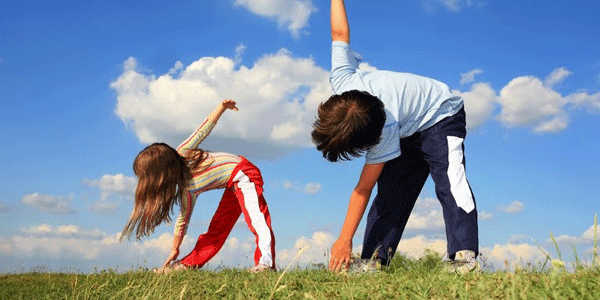
How To Do Yoga for Kids

If you've been "on the mat" for years, and have "down dog" down pat, you may wonder at some point, "Why can't I let my kids practice with me?" (If your child is like mine, she may have already invited herself onto the mat.) The answer is, "No reason at all," provided that you present yoga to your child in an age-appropriate manner.  
Why do yoga for kids at all? For one thing, adults aren't the only ones who are stressed out these days. School, deadlines, team sports, fundraising activities, family incidents, not to mention friendships and self-confidence issues--all these things can create a tremendous amount of pressure on a kid of any age. Just as yoga gives grownups a little productive quiet time and space to "chill out" and center, it can help children create a safe space where the pressures of being a kid aren't quite so overwhelming--to say nothing of the substantial physical and mental benefits that flow from a healthy yoga practice.  
So, how should you introduce yoga to a child?  Here are some tips to help you both get the most out of your time together on the mat: 
  1. Honor the child's nature. Don't expect yoga for kids to be the same as the yoga you practice in class. You have to take a different approach with children, and odds are, a kid who's new to yoga isn't going to demonstrate the same silent intensity of focus to which you may be accustomed. Don't think you're going to force a little one into a silent flow of poses for thirty minutes--you will simply end up frustrated and the child will wind up bored beyond tears (and likely, turned off of yoga for quite some time to come). Instead, let the child be a child.
  2. Use the poses as a foundation to explore other movement in creative ways. Children aged six to nine, especially, enjoy adding the appropriate sounds to poses named after animals. So much for quiet time! But go with it, and you'll get an added benefit, that might not be immediately apparent, by modeling flexibility; you'll help the child grow more flexible and adaptable himself.  
  3. Encourage the use of sound in yoga for kids. Hissing like a snake in cobra pose, or roaring like the lion in lion pose aren't the only ways you can do this. Encourage the child to count while holding an asana, or recite the ABCs. This will enable the child to reap the benefits of maintaining the poses (thus increasing strength and balance) by using his innate love of his own voice.  
  4. Explore the natural world with the child while performing the asanas. Kids are famous for their imaginations. Use and encourage the development of that creativity by urging them to go beyond what the pose appears to be. Ask questions such as "Can you imagine what it would feel like to be a snake with no arms or legs?" while the child is in cobra pose, or "What do you think the lion would do if another lion walked into his home?" in lion pose. Encourage the child to imagine what it would feel like to really be a mountain in Tadasana. Eventually, the child may start to realize the interconnectedness of life on this planet through these explorations--that we are, in fact, all the same, albeit in different forms.  
  5. Let go of your agendas and expectations. Allow yourself to think of your role not so much as a teacher, but as a guide. Let the child tell you where he wants to go. It's then your job to get him there safely and empower him to experience the journey fully.  
  6. Resist the urge to perfect the child's performance. Parents especially, with the best of motives, want their children to excel and improve. But this competitive spirit is at odds with yoga generally. Undoubtedly the child gets enough competition in his or her daily life. Let the time on the mat with you be different.
  7. Encourage the child to honor her body. If she's tired, suggest some "lying-down" poses, for instance. Reinforce the idea that, as long as the little yogi or yogini is moving and breathing, the yoga is already perfect.  
  8. Finally, be aware of physical limitations. A child's flexibility is awe-inspiring, but little bodies have young bones, muscles, and cartilage, and should be treated accordingly. Don't push your child to go beyond his or her physical limits. Encourage the child to ease into more difficult poses. And teach by example:  Don't force yourself into a balancing handstand if it's beyond your capabilities. Play at the edge, not beyond it.

How To Encourage Kids to Exercise

With so many fun and interesting things to do indoors, it can be a challenge to encourage kids to exercise. Surfing the Internet, watching television and playing video games are the favorite pastimes of today's kids. Here are some tips that will help you motivate your children and get them moving.
    1. You must make exercise a part of your lifestyle. This means that you have to exercise, too. With our busy lifestyles, it is sometimes hard to take the time we should to exercise. However, if we want to show our children that exercise is important, the best way to teach them is to lead by example. If they see you taking an interest in getting fit, they will be more inclined to do so, too.
    2. Understand that the earlier children are introduced to physical activity, the more inclined they will be to make exercise a part of their personal lifestyles as they grow and mature. Most young children are excited and easy to motivate. If your child is already in their teen years, don't despair. It is not too late to get them interested in physical activities. Despite what many parents think, teens are impacted by the actions of their parents. It may take your teen a while to see that you are serious about exercising and getting fit. But, once they see that you are, they will generally follow suit.
    3. You should allow children to pick and choose what form of physical activity they want to engage in. Talk to your child to learn what his or her interests are. Exercise doesn't have to mean doing sit-ups or jogging. The key is to simply get your child's body moving. One child may want to dance or bicycle, while another may prefer to roller skate or jump on the trampoline. Very young children can benefit from tricycles, jump ropes, or playing hopscotch. A simple game of kick-ball or throwing a frisbee is an easy way to get a younger child moving. Older teens may be motivated by joining a local sport's team, health club or enrolling in a dance class. Find out what your child would like to do and make the necessary arrangements for them to be able to do it.
    4. Lastly, make physical activities a part of your family's life. Take your family outdoors to places that are fun and beneficial to everyone's health. This can be simply walking your pets through a dog park, going water or snow skiing, taking nature walks, or hiking in a national park. When a family learns how to be active together, bonds, relationships and even muscles are strengthened.

    How to Lose Belly Fat Fast for Kids

    Belly fat in children is a strong indicator of what their health will be like as adults. Many kids with belly fat grow up to have heart and cholesterol problems, and are prime candidates for heart disease and diabetes. However, this can be reversed if the child loses their belly fat and adopts a healthier, more active lifestyle. It takes a lot of discipline, but it will leave your child feeling healthier and happier and help instill better long-term lifestyle choices. 

    Tips For You


    1. Cut down on fast foods and foods that are high in fat. These foods are not only high in fat and calories, but also high in carbohydrates, which contribute to belly fat. Cutting down and eliminating these foods will dramatically increase the chances for kids to lose belly fat.
    2. Incorporate healthy foods, such as fruits, vegetables and whole grains, into the diet. Keep proteins such as meats to smaller portions, filling up primarily on fresh vegetables.
    3. Completely cut out foods that are high in sugar, fat and carbohydrates, such as bread, pasta, cakes, white rice, pizza, pastry, candy, soda and ice cream.
    4. Enroll your child into sports to help increase exercise. Sports are a fun way for children to exercise without it seeming like a chore. Engage your children in more activities such as hiking, swimming and cycling, rather than letting the child spend the day at home playing video games. The more the child moves, the more calories they will burn, turning fat into muscle.
    5. Don’t put the child on a fasting diet. This means the child will get less food, but it also means the child’s metabolism will slow down, telling the body to hold onto any fat that it gets to keep the child from starving. Instead of cutting down on foods, make sure to give the child healthier meals and smaller portions, so that they can eat four to five portioned meals a day, rather than three large meals.