Showing posts with label Gym. Show all posts

Importance of Gym and Fitness

Having a healthy and fit body is a dream of everyone who is health and beauty conscious. In the modern era, whether a man or a woman, everyone wants a pleasing personality and that is the reason why they choose gym facilities to polish up their bodies to their required status. Many professions such as acting, modeling, sports, etc. also need pleasant and good looking bodies for their professional image. Today, even a child is conscious of their health.

In olden times, people were very busy with their lives and were engaged in their professional tasks so they didn't require any special activity to remain healthy and fit. Their everyday work was enough for their exercising, but with the time, the things have been changed and now people need to do special activities to get fit and remain in shape.

Today, the professions have been changed. Earlier, people were busy with farming and this requires very hard work. As they were hard working, no extra effort was required to do for their body. But today, with an advent in IT, people do require extra effort to keep their body in shape and size. ITs jobs are desk based jobs and require mental work rather than physical labor.

There are gym and fitness equipments for everyone. It depends on the requirements and demand of the body.

The fitness equipments are apparatus used enhancements of the body and its structure. If an exercise routine is followed properly, then there is a very low chance of getting any health trouble. A proper exercise schedule also enhances the body appearance of the person following it. The proper usage of an exercise or fitness equipment is an important factor in following the exercise routine. An improper usage of these equipments may have adverse effects. Mishandling the equipment may result in injuries from simple to serious injuries. Extreme injuries occurred from the improper usage of fitness equipments might result in the death of the person.

Types

There are several types of exercise equipments used worldwide for exercising and other purposes. Most popular of them are cardiovascular equipment, strength training equipment, rowing machines, abdominal equipments, weights and exercise balls. All equipments have their own advantage and are used for different purposes. Like the strength training equipments are mostly used by men who are conscious in body building, cardiovascular equipments are having a great category of fitness machine not only for the health conscious people but also for patients who are having cardiac problems.

The abdominal equipments are designed for strengthening the muscles of the abdomen. For toning the abdominal muscles medicine balls are also used. Rowing machines include hydraulic resistance and water resistance rowing machines. In hydraulic rowing machines pistons are used as resistance. In water rowing machines, water is used as resistance. You can buy gym fitness equipment from free classified site as they offer the best deal for your price.

One thing must be taken care of, you must not exercise in excess otherwise it will harm your body. Fitness equipments are great, if you use them in a proper manner

Learn About Fitness Equipment for Home Gym

Putting physical efforts at the gym is bit difficult as many feel that it's boring. But if you start learning with each gym equipment and its nature of work, you really feel wonder and come out of thinking monotony.

There are two types of different equipment, the cardio and weights. Treadmills and bicycles come under cardio section which can be helpful to keep heart healthy as well as burning fat. If you are really looking for toning your body then cardio session can change your health prospects. Unlike cardio, weights will work out for shaping different parts of body.

Look at some weights here:


Dumbbells: Most economical and important gym equipment. These are known as smaller version of barbells and can be found different types weighted dumbbells in the market.

Weight plates: These are targeted to use for certain specialized weight exercises.

Benches: You can buy various types of benches like abdominal benches and weight benches. As per the requirement, you can use.

Barbells: These are long bars where you can keep weight places at the ends of bars. One can add weights or subtract too.

If you have to go to gym twice in a day is not possible as people are busy with daily routines hence, you can buy required fitness equipment to practice at home. Since online has been the best option to buy products, many are looking forward to purchasing it. Whether you buy from Fitness Equipment, try to focus on product quality and start spending time. Physical work outs are essential part in daily life as most of us are having food which has more calories and fat content. Obesity and other health issues are due to lack of physical activities.

Buying products through online is said to be the best mode of shopping as plenty of offers round the year to buy. A few firms are offering high quality products for reasonable price along with free shipping. When you come across such portal, it is better to buy them to start your own gym at home.

You might be young or old, physical activities can help the person to maintain good health. Of course, eating quality food is also an important for an healthy life. It is known to us that no one can away from work so being healthy is not negligible. As long as we are healthy, we can spend more time to work and earn money.

5 Great Cardio Exercises That Don't Need The Gym

If the cost of a gym membership is too expensive and stopping you from getting fit and into shape there are effective cardio exercises that you can do that don't need the gym. Cardiovascular exercise is regarded one of the most important components in any fitness program because it helps to improve energy, enhance muscle tone and aid better sleep.

1. Cycling.

Cycling is a great cardio exercise and it's an excellent way of getting out and about. You can usually buy a second-hand bike at a good price. Start by scheduling a specific time of the day to go cycling or combine the exercise into your daily routine like riding to and from work. When you cycle regularly, it will help you burn calories, improve leg strength and tone your leg muscles.

2. Jump Rope.

A jump rope, or skipping rope, is a great way to exercise at home. This workout focuses on a broad range of muscles in both your upper and lower body. Using a jump rope for at least half an hour each day will strengthen and tone the muscles in your shoulders, core, arms, chest, thighs, back and legs. Also, it will develop your cardiovascular health, burn loads of calories and improve your coordination.

3. Walking.

Walking is a safe way to exercise and is even more enjoyable when you go with a friend. Whilst chatting to your friend as you walk, walking strengthens your leg muscles, lowers your blood pressure, helps with weight reduction and improves heart fitness. The best way to perform this cardio exercise is to walk daily at moderate intensity for 30 minutes or more.

4. Running And Jogging

Running and jogging are high-impact cardio exercises that you can do away from the gym. When done daily for about 30 to 60 minutes running helps maintain a healthy weight as it burns a lot of calories. It also improves heart health, adds years to your life, improves brain health, elevates your mood and strengthens your bones, joints and muscles.

5. Swimming.

Most people enjoy a dip in the pool, so why not turn that dip into some laps as a form of exercise? The great thing about swimming is that everybody can do it and enjoy it. It's suitable for every age group and fitness level. Swimming works your whole body but mostly targets your back, shoulder and arm muscles. Swimming also improves your flexibility, builds endurance, keeps your heart rate up and helps you maintain a healthy weight.

How To Lift Weights Effectively

Maybe you're sick of being a 98 pound weakling; maybe you have a sports injury that needs rehab; maybe you want to build bones of titanium or buns of steel; or maybe you just want to do one of the best activities for getting lean and strong. In any case, you've finally gotten enough courage to go into the free weight section of the gym. Now what? How do you make sure that you're getting the most bang for your buck? 
  1. Choose free weights over machines wherever possible. Your body is meant to move freely, in three dimensions, not strapped into a machine that only lets you move your pinky finger. Free movements such as squats, pushups, and rows not only help you get stronger, they also help build balance and stability for sports and the demands of real life - very handy when you're struggling to haul a couch up your narrow apartment stairs!

  2. If you must use a machine, the adjustable cable station machine is a good option.The adjustable cable station machine is one of the few pieces of equipment that's useful, especially if you can adjust the handle attachment position to any height. (Some machines only allow you to clip handle attachments to the top or bottom position.)
  3. Start small, and focus on technique. Free weights come in all sizes from soup cans to big heavy plates and barbells. You don't need to leap into a 300 pound squat on your first day. Focus on learning the movement properly, and practice doing it correctly. A great site with plenty of helpful exercise pictures and descriptions is ExrRx.net 
  4. Start with a few sets and build up your endurance. Beginners should start with one to two sets per exercise (one lighter warmup set plus one heavier working set is good), 12 to 15 reps per set. Using lower weights and higher reps at this point helps condition the joints and teach exercise technique. After six months or so, feel free to start going a little bit heavier and adding sets.
  5. Use a full range of movement. Part of good technique involves taking the joints through a full, natural range of motion. Don't stop the movement short in order to lift more weight, but don't overstretch beyond your normal, comfortable range either.
  6. Do exercises that work many muscles at once. Don't waste your time with a bunch of little tiny exercises that only work a muscle or two. Go for the big kahunas, the exercises that hit many parts at once, and involve more than one moving joint. For example, in a seated a leg extension (in which you sit and straighten your leg against resistance), only the knee joint moves, and only the quadriceps muscles are really involved. But if you squat with a barbell on your back, your hip, knee, and ankle joints move, and everything from your upper back downwards is involved. Pretty good deal! Good compound exercises include squats, deadlifts, presses (such as overhead presses, incline bench presses, and pushups), rows, and pulldowns/pullups.
  7. Work your whole body. Don't focus just on a few parts (biceps curl and bench press boys, you know who I'm talking to).
  8. Rest between sets. Organizing exercises in a superset or circuit helps save time. For example, you can do a set of squats then a set of pushups, then a set of squats, and so on, and you'll less rest in between since you're working different types of movements.
  9. Breathe. You'll naturally hold your breath a little during the heaviest part of the movement (try to keep your loud grunting to a minimum unless everyone around you is wearing their iPod). This is quite natural, and helps keep your midsection stable so that you don't collapse like a wet noodle. But don't hold your breath for longer than a few seconds. Exhale as you come to the end of the rep.
  10. Avoid taking a weight set to failure if possible. Failure occurs when you are truly, positively, even at gunpoint unable to lift the weight one more time. Complete each set so that the last rep's form is as good as the first, and leave a rep or two left "in the tank". This will help you recover faster and lower your risk of injuries.
  11. Avoid injuries. Check your ego at the door. Think of weight training as a long term project. Be smart and be safe. Use common sense.
  12. Warm up with moderate cardio and practice sets. Warm up with a few minutes of moderate cardio, and then practice the weights movements, taking the joints gently through their range of motion. Do a warmup set or two with lighter weight before attempting something heavier. This prepares the body for the loading as well as the movement itself.
  13. Save most of the stretching for after your weights workout. Static stretching (i.e. the standard stretch-and-hold type stretching) has been shown in lab studies to weaken muscles temporarily. Contrary to common opinion, stretching before a workout doesn't decrease the risk of injury or post-workout soreness either; in some studies it even increased both of those things.
  14. Save your main cardio workout for after weights.

How To Do Bodyweight Exercises

Thanks to the modern gym movement, people often think of exercise and resistance training as something that requires a lot of special equipment: a big pile of weights; a roomful of machines; some contraption with elastic bands or springs; or some high-tech gadget with lots of buttons and light-up displays that makes bleepy bloopy sounds.

Nothing could be further from the truth.

Humans have gotten fit and strong using their own bodies, gravity, and some imagination for thousands of years. This isn't to say that additional exercise equipment isn't useful - it certainly is, especially if well chosen and appropriate. But bodyweight training can be a great addition to your "exercise toolbox": it's versatile, you don't need anything besides your bad self, you can do it almost anywhere, and it can be applied to a number of goals or tailored to an individual's ability. It also gives you loads of stability and balance, especially as you get more skilled and start doing movements with only one hand or leg.

Bodyweight movements fall into a few categories: 
  • Pushing.  Pushing motions work the shoulders and triceps primarily, and these can be in three directions: pushing overhead (as in a handstand pushup); pushing horizontally away from you (as in a regular pushup); and pushing down (as in a dip).

  • Pulling. Pulling motions work the back, biceps, and forearms primarily. With bodyweight exercises these are usually in two directions: pulling something down from overhead (as in a pullup or chinup); and pulling horizontally (as in a row, but for a bodyweight exercise this would be a horizontal pullup, which looks sort of like an upside down pushup).
  • Squatting. One of the best all-round exercises for developing leg strength. Bodyweight squats are a good challenge on their own, especially if you set yourself the task of very high rep sets (100 or even more). Try varying foot position and experiment with a range from very wide to very narrow stance.


  • Jumping. Jumping practice is useful for helping improve performance in many sports. There are lots of ways to jump: explosively upwards from a squat position; over things or onto things (such as a step); in different directions (front, back, sideways, zigzags); moving the feet around (e.g. switching feet rapidly in midair to alternate landing in a lunge position); or even jumping rope.
  • Bridging and static holds. These are helpful for training isometric strength (namely, the ability to hold a particular position), and many holds help improve the strength-endurance of midsection muscles (such as the spinal erectors and abdominal muscles). Examples of bridges are the classic wrestler's bridge, the plank position of yoga (essentially the top position of a pushup with weight on hands or forearms), and the modified glute bridge (where you lie on your back, feet on floor and knees bent, then squeeze the glutes and straighten out the body, lifting the butt off the floor).

  • Now that you've got the basics down, there are lots of ways to mix it up.  
    1. Try movements with one arm or one leg. For instance, you can squat with one leg held out behind you, in front of you, or to one side. You can jump on one leg, push up with one hand, or do a one-handed pullup (if you're really tough).

  • Try movements with body weight asymmetrical. For example:

    • Pushups with most of your weight on one side, over one hand
    • Pushups with one hand elevated
    • Pushups with one hand in front and one behind
    • Pullups using a small towel or rope hooked over the bar, so that one hand is on the bar and one hand is lower down, gripping the towel
    • Pullups where you pull towards one side

  • Try movements in different directions. For example, try lunging to the side, or 45 degrees in front of you. Or try a plank position with body facing one side.
  • Use explosive movements. Once you've mastered the basic technique, experiment with making some movements explosive. For example, try clapping your hands underneath you with each pushup - you'll have to push up powerfully and explosively to get enough airtime to make this work.
  • Change the angle of the movement to make it easier or harder. For example, elevating your hands will make a pushup easier; elevating your feet will make it harder.
  • Add intensity/duration. Work up to as many reps per set as you can, or try going for more but shorter sets (for instance, 10 sets of 5).
  • How To Convince Yourself to Go Back to the Gym

    Exercise is vital to our every day lives. It enhances and preserves our body’s physical form and general heath. By doing this you enhance your muscles to get fit or to lose unnecessary weight. By usual exercise you can improve the body’s immune system and helps you to avoid illness and diseases. It also advances your mental and physical condition. This also helps you avoid anxiety.
    Many people nowadays have different kinds of excuse to avoid going to the gym and work out. The time to commit, having anxiety related issues in facing other people inside the gym and the pricing of the gym’s membership. Imagine your future and the result of your daily lifestyle without going to the gym. Just think about adding some additional years for your existence by going to the gym and working out to promote a healthy body and a good lifestyle.
    Here are some points to get you motivated to go to the gym
    • Just face the fact that a person can’t stay young.
    • Convince your self that you need to stay healthy and physically fit.
    • Going to the gym helps you to make friends and socialize instead of staying at home watching the television.
    • Your body is sacred you should treat it well.
    • Ask your self why other people have good body and are physically fit and you don’t?  So why don’t you do the same thing to stay fit.
    • Going to the gym makes you stronger and in shape, these alleviate stress and anxiety.
    Here are some steps so you won’t lose drive going to the gym.
    1. Secure your work out schedule. So you don’t have any reason to skip going to the gym.
    2. Find a gym that is close to your office or to your house, so you don’t have to spend a lot of time going there. And it will be efficient and you can work out regularly.
    3. Membership might be expensive, so you need to check out and get a good deal. Some gyms gives affordable prices if you sign up for long term membership.
    4. Look for a friend or a family member who is interested to go to the gym and who will serve as your workout buddy. Some gyms offer cut rates and discounts if you register with a buddy. This will help both of you to motivate each other.
    5. Be more productive and try to socialize with others inside the gym, so you will gain more friends, and to develop interest in what you are doing.
    6. Hire a trainer. This is a good investment you don’t want to throw away. A trainer gives you routines and programs to work on. This will motivate you to go back to the gym.
    7. Listen to music or watch video exercises while you work out to make you more motivated.
    8. Get some pictures of yourself before you start the program, after you meet your goals on the said program. Check the difference between your old picture and your present physical form. This will motivate you more because you have seen the effects of your hard work.
    9. Lastly, be proud of what have you become and what you have achieved after reaching your goals.
    By doing this steps you will see a big difference on your physical and mental state. You will be motivated to go to the gym and work out.

    How To Use a Bowflex Extreme

    Working out to build muscle or lose weight is not a joke because you have to exert a lot of effort- like, going to the gym everyday- just to achieve your dream body. However, the use of Bowflex Extreme can make it a little easier for people who go to the gym everyday since this is an equipment meant to be installed at home.
    This machine is designed to let you build your muscles. You can do about 60 different types of exercises with it. This is more convenient than going to the gym because with this, you can build your body in any way you want.
    Bowflex Extreme is priced at roughly around $2,000. It is quite an expensive piece of equipment but it is sure to bring convenience to people especially if you are going to change from one exercise to another. This is especially true since you do not have to decrease or increase the weight being lifted.
    This is because there are power rods in the machine where the pulleys and cables are hooked. So if you want to lift heavier weight, all you have to do is to make the rod diameter wider. Here are the steps on how to use this home gym system.
    "No change cable pulley system": With this machine, you do not have to replace the cables and pulleys if you are going to change exercises. This system will help you focus on your chest more, from your upper chest to your lower chest. You can execute the chest press exercise here, as well as the fly exercises. Also, your shoulder muscles can be built using this equipment through shoulder presses, raises, reverse flies and upright exercise.
    Leg Exercises: Some people do not focus on their legs because it feels mundane to shift weights where you have to bend all the time. But with this machine, you can use the lower pulleys to be able to execute your leg exercises, such as dead lifts and squats which will help you develop your hamstrings and quadriceps.
    Abdominal Exercises: This machine also provides exercises for abdominal muscles. It includes a cushion seat where you can execute your trunk rotations and crunches.
    Back Exercises: The bar behind the seat is for you to do a front, back, or reverse lateral pull down exercise that will help you develop your back muscles.
    Arm Exercises: The pulley system for your chest and shoulders can also be used to do triceps and biceps exercises. You can do tricep extension and push down, a few curling exercises for your biceps, and wrist curling for your forearm.
    If you really want to achieve the body that you want and think that going to the gym is just a waste of time because the gym is far from your place, you can purchase this incredible machine that will provide you with many exercises. Even at home, you can execute the exercises on your own, and also will save you a lot of time from travelling to the gym.

    How to Get a Six-Pack Without Weight Training

    A strong six-pack takes a lot of hard work and dedication. Yet, if you don’t like using free weights or don’t have access to any, that doesn’t mean you have to say goodbye to having strong abs. There are many powerful ab exercises that do not require the use of any weights at all. By working your abs at least three times per week and by performing three sets of each exercise during each workout session, you may have a six-pack before you know it.

    Tips For You


    1. Warm up by walking or jogging for 10 minutes.
    2. Do the wide-legged criss-cross. Lie on your back on a mat. Place a pillow in between your thighs and lift your legs up into the air. Put your hands behind your head. Lift your head and shoulders off of the floor and bring your left elbow toward your right leg. Return back to the middle. Do 20 repetitions then repeat the exercise on the other side, bringing your right elbow toward your left leg. Do 20 repetitions on this side as well.
    3. Perform the walk-out. Get into a push-up position. Tighten your abs. Move your hands out slightly wider than your shoulders then continue to walk outward with your hands as far as you can without falling. Walk back to the starting position with your hands. Repeat 12 times.
    4. Complete the mountain climber. Place your hands on a bench and walk your legs out until your body is in a diagonal line. Tighten your abs. Bend your right knee and bring it toward your chest. Lower it back down. Repeat 20 times on each side.
    5. Do the air bike. Lie on your back on a mat. Lift your legs so that your calves are parallel to the floor and your knees are bent 90 degrees. Place your hands behind your head. Lift your head and shoulders off the floor. Bring your left elbow toward your right knee as you bring your right knee toward your left elbow. Then return through the starting position and bring your right elbow toward your left knee as you bring your left knee toward your right elbow. Repeat 15 times alternating sides as if riding a bicycle.
    6. Cool down by walking or jogging for 10 minutes.
    7. Lose extra body fat so that your six-pack is actually seen and not buried by a layer of fat. Reduce your daily calorie intake so that you have a deficit of 500 calories per day to lose approximately one pound of fat per week. A calorie deficit occurs when you burn more calories that you consume. Perform cardio at least 30 minutes every day to help burn calories and achieve the calorie deficit to lose extra fat.


    Fastest Way to Get a Six Pack at Home

    Six pack abs are an aesthetically pleasing indicator of personal fitness. You can get a six pack at home by carrying out a few different exercises on a regular basis to increase the size and strength of your abdominal muscles. However, this is only part of the process. More importantly, you need to reduce your body fat. Everyone has a six pack, but they are seldom visible because of the layer of fat on top of them. To reveal your six pack, you need to eliminate this layer.

    Diet

    • One of the easiest ways to reduce your body fat is to change your diet. Eliminate alcohol, soda, fast food and processed foods from your diet, and increase the amount of vegetables you eat. Next, reduce your portion size across the board -- use smaller plates or try to make a point of always leaving some food on your plate. Finally, change your diet to reduce simple carbohydrates, which come from processed wheat and sugars. So, you should have wheat bread instead of white bread and whole-grain pasta instead of standard pasta.

    Compound Exercises

    • Compound exercises work entire muscle groups and almost always include the abs to stabilize. Examples include pushups, squats and hanging leg raises. Pushups work your triceps, back and chest while keeping your back straight with your abs. Squats work your legs but also engage your abs to keep your back straight, and hanging leg raises are the converse -- they engage your abs and legs, but use your arms and upper body to stabilize.

    Abdominal Exercises

    • Abdominal exercises focus on your six-pack muscles. Examples include situps and crunches, but there are more complex examples. You can, for example, target your obliques by lying on one arm with your body at a 45-degree angle to the ground, then raise one leg, and then slowly lower it. Or, you can work your core abdominal muscles by lying on the ground and bringing your arms and legs together at the same time, keeping both straight to make your body into a V. This works your entire core and develops your six-pack muscles.

    Interval Cardio

    • Interval training is when you work hard for a short time, then work at an easier intensity, and then speed up again. You would repeat this process for around 20 minutes. A good at-home interval training is to jump rope. Warm up with slow jumps for around five minutes, jump as hard as you can for 30 seconds, and then slow down for a minute. Repeat the exercise over again for the 20 minutes.
      You can increase the intensity in a variety of ways. You can just jump faster if you want, or you can add double jumps where you were previously doing single jumps. It is not really important as long as you work harder in your intervals than you do in your rests.

    How to Easily get Six Pack Abs

    Follow all these steps and I guarantee you will be on your way to getting six or even eight pack abs.

    Things You'll Need

    • Motivation
    • Dedication

    Tips For You

    1. First you need to make sure you get your diet in check. You will need to eat small meals several times a day. You need to eat a low amount of calories, high protein, low carbohydrates, low fat diet. Your meals should consist of baked chicken or fish, healthy carbohydrates(brown rice, etc.), and vegetables. NO fried foods and replace all unhealthy snacks with fruits or nuts. NO sodas. If you are looking to lose weight too and not just tone up eat 500 calories lower than your maintenance calories amount. (There is a link to a calorie intake calculator at the bottom.)
    2. Second, do 45 minutes of cardio a day. If this is too much for you just work yourself up to it eventually. This is going to help you get leaner quicker and if you would like it can be done right before your ab workout and will increase your fat burning and speed up the whole process.
    3. Now last is your ab routine. This I will leave up to you to personalize your routine so I have included a link to a database of 50 ab exercises with detailed video and instructions. I recommend choosing 4 or 5 exercises you like best as your routine. It is a good idea to switch up exercises so your muscles don't get too familiar with your routine. When you are putting together your routine don't forget about you obliques.
    4. (Optional) You can take a fat burner to speed up the process. I don't recommend this unless you have a lot of fat to lose. You should make sure you are healthy enough to take a fat burner before using it and that you do not have heart problems. I don't take fat burners because I have a high metabolism anyway, but I would recommend either Lipo-6 or Hot-Rox.
    5. (Optional) Adopting a circuit training full body workout plan can assist in fat burning and toning. You can find a circuit training plan on bodybuilding.com

    How to Stretch Lower Abs

    The lower abdominal muscles perform the important function of helping protect the spine from injury. Preparing these muscles before and after exercises helps you get the most out of your workout. Stretching also has an added benefit in causing your muscles to continue working well after your warm-up, workout and cool down are complete. As with any stretching activity, proper posture is the key to correct warming up a muscle group. Keep your head straight with eyes ahead, shoulders relaxed and your back straight.

    Tips For You


    1. Cobra stretch. Lie flat on your stomach, hands positioned flat on the floor below your shoulder (like a push up position) and with the tops of your feet flat on the floor. Gently push your body up with your hands to straight arms. Don’t arch the back too much. Your aim is to feel a gentle pull in your lower tummy area. Hold for a 10 count, lower back down to the ground. Repeat 5 times.
    2. Standing abdominal stretch. Stand with feet shoulder width apart. Place the hands, with fingers down, on the back of the hips. Focus on keeping proper posture with a straight back and relaxed shoulders. Slowly lean back just a little and lift your chest up to the ceiling. You should be feeling the stretch in your lower abdomen. Hold for a 10 count and relax. Repeat 5 times.
    3. Lying abdominal stretch. Lie flat on your back with straight legs and arms extended over the head. Slowly reach with your arms by lifting the chest only and stretching the lower abdomen. Hold for 10 counts and relax. Repeat 5 times.


    How to Get Chiseled Abs

    Tired of that flab around your stomach? Frustrated that after all this time in the gym you still can’t see your abs? In order to actually get a chiseled stomach you have to have both your diet and your exercise routine fine tuned. These steps will teach you everything you need to do to get the six-pack you’ve always wanted.

    Things You'll Need


    • dumbbells, weight plates, treadmill

    Tips For You 


    1. Perform a cardiovascular exercise a minimum of three times per week.
    2. Run for 20-30 minutes. Sustain a heart rate of 60-75% of your maximum heart rate. To calculate your maximum heart rate, subtract your age from 220.
    3. Slowly drop your calories. Drop your daily calorie intake incrementally by 100. Start the first week and decrease accordingly each week.
    4. Keep your protein intake high. Start by slowly lowering your saturated fat intake. Don’t cut the fat out completely, as you could negatively change your hormone levels. Also, slowly lower your carbohydrate intake.
    5. Now that you have a healthy diet and cardio regimen in place, you should start to see results for all your hard work. Because the abdomen recovers quickly, you can exercise the area more often than you would any other muscle group. Try to work your abs at least 3 times a week.
    6. Weighted Sit-Ups: Lay on your back with your legs bent. Keep your knees pointed upwards and held together. Your feet should remain flat on the floor. If you can, pin them as well. (A weight plate should provide control and assist you as you complete the exercise.)
    7. Place a sufficiently heavy weight plate on your chest and fold your arms across it. While focusing on contracting your abs, bring your upper body towards your knees. Wait a beat, then lower your back to its original starting position. This is one rep.
    8. Perform eight to twelve repetitions for four sets. Rest one minute between each set.
    9. Side-Bends: Stand straight with your feet shoulder-width apart and firmly on the floor. Hold a sufficiently heavy dumbbell or weight plate in your right hand.
    10. Lower the right side of your body. Bend at the hip so your shoulder dips toward the floor and the hand holding the weight drops straight down. Focus on contracting your abs. This is one rep.
    11. Perform eight to twelve repetitions for four sets. Then repeat with the other hand.
    12. Leg-Lifts: Lie on your back on a flat bench. Keep your shoulders and the small of your back pressed against the pad. Most of your lower body should hang off the bench. Hold onto the side of the bench for support.
    13. Place a 5 or 10 pound dumbbell between your feet and slowly raise your legs up towards the ceiling until they’re almost perpendicular to the rest of your body. Then slowly lower them back down until your legs are level with your upper body and the bench. This is one rep.
    14. Do four sets of eight to twelve repetitions. Break for one minute between each set.


    Daily Workout Plan to Lose Weight Without the Gym

    Losing weight doesn’t require signing up for an expensive gym membership. Wilting away the pounds with an at-home workout is not only convenient, but it's also effective. Whether you have your own personal home gym or no equipment at all, you can lose weight and get your heart rate soaring every day. Keeping it simple and consistent can be the difference between a successful weight loss journey and a doomed one.


    Cardio Workout

    Daily Workout Plan to Lose Weight Without the Gym

    Performing a daily cardio workout at home will help you melt away fat and lose weight, and the health benefits are worth their weight in gold. Any movement that increases blood flow throughout the body and revs up your heartbeat is considered cardio. Benefits include weight loss, increased metabolism, a healthier heart and an increase in those feel-good hormones, according to Weber University. Walking, running and cycling will get your heart pumping. If the weather is bad or you just feel like staying indoors, get in a cardio workout by performing exercises such as jumping rope and doing burpees (squat thrusts) and jumping jacks.

    Strength Training

    Daily Workout Plan to Lose Weight Without the Gym

    Strength training is crucial when it comes to weight loss. Building muscle underneath the fat will help to burn extra fat cells. The more muscle you have, the more calories you burn at rest. Body weight exercises such as pull-ups, crunches, squats, lunges and push-ups don’t require equipment and can be done just about anywhere. Free weights are easy to store and can offer you even more variety in strength training. Include free-weight exercises such as biceps curls, triceps extensions, dumbbell step-ups and and dumbbell presses.

      Frequency

      Daily Workout Plan to Lose Weight Without the Gym

      As a rule of thumb, you should complete at least 30 minutes of physical activity per day, according to MayoClinic. With cardio exercise, 150 minutes per week of moderate intensity or 75 minutes per week of vigorous activity will suffice. Include at least two days per week of strength training exercises. You can break up your workouts throughout the day and still lose weight; just make sure the mini-sessions are at least 10 minutes each.

      Cut the Calories

      Daily Workout Plan to Lose Weight Without the Gym

      Exercising alone won’t get all the pounds off, especially if you replace the calories burned during workouts with extra food. To speed up weight loss, consider cutting calories daily. Changing your diet and reducing calories promote weight loss more than exercise alone, suggested MayoClinic's Dr. Donald Hensrud. To lose weight the healthy way, aim to lose one to two pounds per week. To drop just one pound of fat you must have a caloric deficit of 3,500 calories per week. You’ll need to burn off or cut 500 calories per day to achieve this weekly one-pound weight loss.

      I Overdid It At the Gym. Now What?

      with it comes a fierce determination to get back to the gym. Perhaps the holidays caused you to neglect your workouts. Maybe you haven’t been back to “your” gym since you signed up last January. Whatever the reason, you put on your gyms shoes and said hello to the weight room again. It felt amazing to move your body as you pushed forward, full steam ahead!

      Then you noticed your legs felt a little like jelly walking out of the gym. Maybe, as you hoisted your gym bag over your shoulder, your arms felt a bit weak. Take note! Your body is trying to tell you something. You may have overdone it.

      Delayed Onset Muscle Soreness, or DOMS, is a normal reaction to starting a new fitness program or even changing up the types of activities you do. Normal, however, doesn’t make it any more pleasant. Minimizing the soreness starts immediately when the workout ends, by stretching and using a massage roller. Start with rolling, or myofascial release, first, and then move on to static stretching. Myofascial release techniques using devices such as foam rollers, sticks or even a lacrosse ball help work out the knots in the muscles, improve flexibility in connective tissue and decrease the effects of DOMS.

      How you refuel after your workout can also impact the soreness you experience the next day.

      Whey protein is a fast digesting protein. Ingesting it after a workout gets the necessary protein to the muscle quickly to start the recovery and repair process. If you want to boost the power of your protein smoothie, try adding tart cherry juice. Tart cherry juice has an anti-inflammatory compound that acts like a “natural ibuprofen.” Try mixing one scoop of chocolate whey protein powder with 2 ounces of tart cherry juice and 6 ounces of almond milk in a BlenderBottle for a quick post-workout snack.

      Blueberries have a similar effect, boosting the immune system and helping clean up the free radicals created by the stress of your workout. Blend blueberries, spinach and pineapple with vanilla whey protein powder for a nutrient-rich post-workout shake. It's also critical to rehydrate post-workout.

      Rehydrating after a workout is extremely important to the recovery process. Water is necessary for proper circulation, which provides nutrient- and oxygen-rich blood to the muscle, and is also a critical ingredient in the chemical reactions that repair the muscle. A good rule of thumb is to drink 64 ounces of water a day, plus 8 ounces for every 15 minutes of exercise.

      The body does its major repair work while we sleep, making it even more important to get a good night’s sleep after a challenging workout. If you get less than seven hours a night, you're shortchanging your body of much needed recovery time. If you have jelly legs or arms when you leave the gym, try to get to bed a bit earlier, and aim for eight hours. As with most things, it's not just about quantity of sleep but also quality of sleep. Your body does its major repair work during the deeper sleep cycles. If your body doesn’t reach those levels, recovery is going to be impaired. Help improve your sleep quality as well by setting up an environment favorable to sleep.


      • Start winding down about an hour before bed by turning off the television and putting away your smartphone.
      • Keep electronics out of the bedroom. Try reading or meditating instead of checking  Facebook to wind down.
      • Use a sleep mask to block out ambient light.
      • Turn down the thermostat for a cooler environment.

      As tempting as it may be, don’t be a couch potato the day after your workout. Movement helps, just don’t do the same thing you did to become sore! Try a light cardio workout instead, such as going for a walk or riding a bike. Or you might consider a restorative yoga class to help improve circulation and stretch your muscles. Another round of myosfacial release can help as well.

      Don’t work the same muscles until most of the soreness is gone. The next time you go to the gym, pull back on your workout intensity by decreasing the weight, sets or repetitions. The key to real fitness is consistency. That same consistency will also help prevent DOMS. The body adapts to the stimulus you give it. Go too long between workouts, and it forgets. You'll get the rush of a good workout you felt on day one without the OUCH factor if you strength train on a regular basis.

      The Best Fat Burning Routine at Gym

      The workout you do at the gym should depend on your goals. If the goal is to burn fat, the routine should consist of a intense cardiovascular/weight training routine with more repetitions. If the goal is to build muscle, the routine should consist of less cardiovascular exercise and heavier weights training with fewer repetitions.

      Circuits

      "A circuit or super-set training are the best fat-burning routines," Aaron Dibona, a Fitworks personal trainer, said. The key is to keep your heart rate up during the entire time of workout. Do a high-intensity circuit, hitting key muscle groups during the workout, he said. According to Dibona, if you exercise too long (especially with cardiovascular exercises) you will start burning muscle rather than fat. Start with 15 minutes of cardiovascular exercise to get your heart beating fast. Then begin your cardiovascular/weight training circuit.

      Key Points

      The circuit training should consist of primary motions that you would normally work in a natural and consistent way. "They can be broken down into 6 patterns: push, pull, squat, dead-lift, rotation and flexion/extension of torso," according to MAX workouts by Shin Ohtake. Do exercises such as leg presses, bicep curls, tricep push-downs, calf raises, hamstring curls, chest presses, shoulder presses, seated row and squats to be sure you hit all of these primary groups, Dibona said.

      Sets and Repeitions

      According to MAX Workouts, in order to burn the most fat you must move at a quick pace from exercise to exercise. The whole circuit, one time around, should not take more than five minutes. Start slower in the beginning and try to improve your time as you get better, making sure you are still doing the exercises effectively, Dibona said. To optimize fat burn, do a little lighter weight (still making sure it is a challenge) and do 15-20 repetitions. You should repeat the circuit three times. Rest in between sets for anywhere between 45 seconds to 2 minutes and be sure to stay hydrated during workout, Dibona said. Finish your workout routine with a five- to 10-minute cool-down on the bicycle or treadmill and be sure to stretch your muscles.

      Gym Workout Routines to Lose Weight

      Weight loss can be a difficult process to go through. Between diet and exercising, it can be hard to stick to your plan. Dieting in a healthy manner will help your body run smoothly and burn calories more efficiently. Exercising will have the same effect. You can incorporate three main types of exercise that should be done regularly into a gym routine that will work your body and help you lose weight.

      Stretching

      Stretching helps restore posture. With good posture, your blood will flow more efficiently and keep your organs healthier.
      Bend down and touch your toes. Hold it for 10 seconds. Come back up and stretch your arms to the ceiling. Hold that for 10 seconds. Put your left arm in the air and take it behind your back. Keep your elbow pointed to the ceiling. Take your right hand and put it on your elbow. Bend to the right side. Reverse arms and bend to the left. Now take your hands and place them on your hips. Pivot your hips from side to side. Do this for 10 reps on each side. Sit on the ground and push both of your legs forward as far as they can go. Spread them wide. Take your hands and put them on one foot, stretching as far as you can. Hold for 10 seconds. Move your hands to the other leg and hold. Bring your feet together. Stretch your hands towards your feet and hold for 10 seconds. If you can, bring yourself to the crab walk position. This is a position where you will be on all fours with your back facing the ground. Push your back as high as you feel comfortable. Hold for 10 seconds. This routine will keep your muscles limber and fresh and ready to exercise. If your gym offers it, take yoga classes to increase your flexibility.
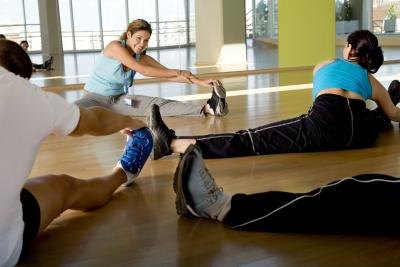
      A class stretches before their workout.

      Cardiovascular or Aerobic Training

      Cardiovascular training is vital to losing weight and staying in shape. Cardiovascular training strengthens your heart and lungs. When you have low cardiovascular health, you will be tired often, out of breath easily and low energy. With high cardiovascular health, you will have extra energy, greater stamina and better drive. It also makes all other exercises easier, so it is important to focus on this aspect of your training. Cardiovascular training can be anything that requires you to exert yourself: running, walking, swimming, jogging or even rock climbing. Pick an exercise you enjoy. Doing what you enjoy is half the battle.
      Make sure you can talk during your exercise. Once you cannot, you are out of breath, and once you are out of breath, it is best to rest. Don't overstrain, and don't set goals you can't reach. Overexertion will tire you out and can hurt your body.
      A diverse use of gym machines can help you burn off a lot of weight. Start easy with the treadmill. Set it for the increased intensity routine. This will slowly increase the speed and incline of the treadmill. Make sure that it never gets too fast or too grueling for you. Run the treadmill for five minutes, then step off and stretch your leg muscles. Next go to the stair-stepping machine. Set it for an increased intensity workout and begin stepping. Be careful you don't step too fast. Five minutes of stair stepping is an excellent start. Next go to a rowing machine for about five minutes. As you work out and your cardiovascular system gets stronger, you will be able to handle a more intense workout.
      Take a moment to stretch your body all over, then find a bicycle machine. Set it for an increased intensity routine. This time, go for about 10 minutes, then stretch your legs and arms again. Finish off with five more minutes on the treadmill.
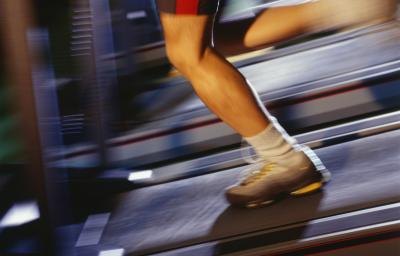
      The treadmill is a good form of cardiovascular training.

        Strength Training

        Strength training can offer many weight-loss benefits. Idle muscles burn more energy than idle fat. By building up strong muscles, you can simply be relaxing while watching a movie and burn more calories than you would if you had less muscle. When you lift weights, you are actually tearing your muscles a little. Your body then repairs the muscles, which makes them stronger.
        Start out with bench-pressing machine. This will work your chest and arms very well. Put on a safe amount of weight for what you can handle. Don't push too hard at the beginning. Do 10 reps to begin, and if you feel up to it, do another 10. Next find a machine that works your arms, back and chest. This type of machine will have two levers to pull toward your chest. Set your weight for a safe level. Do 10 reps, and if you feel comfortable, another 10. Find the machine that lets you work the back of your legs. This will have a bar for your legs that will let you pull your legs upward against the weights. Set it for an appropriate weight and do two sets of 10 reps if you can. Find the machine that lets you push yourself up against weights using your legs. You will push yourself up and away from a pad. Set this to an appropriate level with 10 reps and another 10 if you feel you can. These workouts will have worked your legs, back, arms and core muscles. Vary your routine using different machines every day so that you don't get bored and don't strain your muscles. Slowly increase the exercises you do and the weights you use. Consulting a personal trainer will provide you with optimum benefit out of your exercise routine.
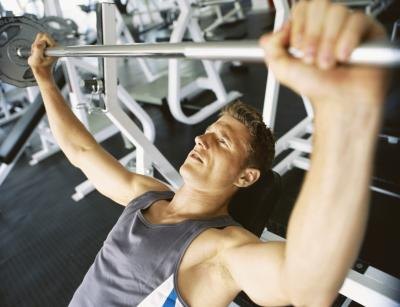
        The bench press or incline press is a good place to start with strength training.